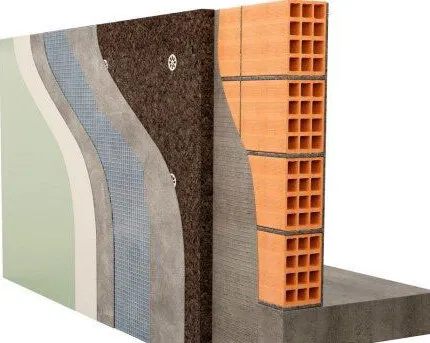
This involves the installation of a new outer layer of thermal insulation that completely covers the existing façade. In this way, elements susceptible to heat loss due to thermal difference or material transmittance are homogenised by this new enveloping insulation.
The SATE system is the result of the current trend of using sophisticated systems from which 50% of the construction components have been removed in order to save costs. It is a thin skin cladding that still meets with some resistance from long-established developers who are used to more common construction elements and works. This, together with the fact that in Spain the application of this second skin is still somewhat complex, means that ETICS is unfortunately not yet the first choice for radically improving the energy efficiency performance of a facade. Another difficulty is that ETICS has to be applied by efficient and specialised labour.
What is the SATE system?
It generally consists of the following components:
- The exterior facing
- 7 to 10 cm of thermal insulation
- 1 to 2 mm of acrylic paste
- Fibreglass mesh
- 1 to 2 mm of acrylic paste
- Painted
- Bonding primer
- Finished morter layer
How does the SATE system work?
It works in a supportive way, where each layer is essential and they all work in harmony.
Avoiding one of these components (which is what sometimes happens in non-specialised companies) can cause the construction solution to malfunction, which can cause problems in the medium term.
In summary, the characteristics of the SATE system in terms of energy efficiency are as follows:
- Removal of thermal bridges
- Rehabilitation of old façades
- Reduction of the exterior-interior thermal gradient
You can contact us to get a quote for the application of the SATE system on the façade.