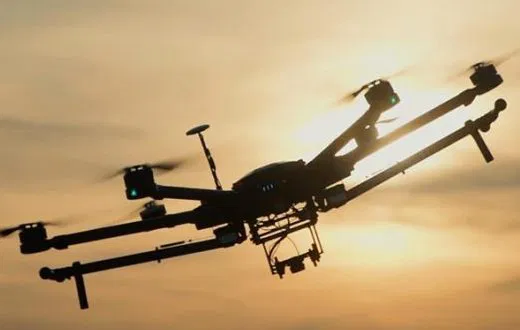
Two types of drone can be differentiated: those in the form of aeroplanes, which have the advantage of gliding and lower consumption, and those in the form of quadcopters, which are propelled by at least four propellers and can move in all directions and remain stationary in the air.
The movement of a drone is based on two forces that always act on it: weight and the force of the propellers. The force of weight is always towards the ground perpendicular to it, regardless of its position. The force of the propellers is always perpendicular to them in the opposite direction to the thrust of the wind.
The drone remains stable by equalising the propeller speeds. When the pitch or tilt command is given, the rear, front or side motors will tilt at the angle corresponding to the action.